

OVERVIEW
Virtual home spirometry
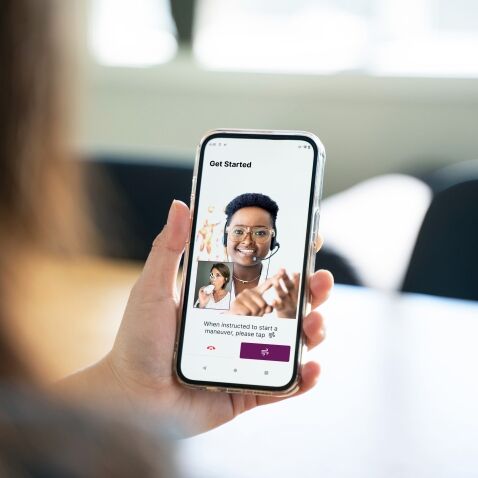
Collect spirometry data remotely via video coached sessions with Clario’s Virtual Home Spirometry solution. Strengthen regulatory submissions with the ability to generate robust data by capturing full flow volume loops at home without compromising functionality.
SOLUTIONS FOR
Hybrid trials

Ultrasonic Sensor with mobile device and application


Clario’s next generation at-home spirometry solution
Convenience without compromise. Capture full high-resolution inhalation and exhalation data points for your hybrid Respiratory trial using the iSpiro® Ultrasonic sensor and a Clario mobile app on a supplied device to enable pulmonary function testing.
ATS/ERS guidelines have identified coaching as a critical factor in achieving reliable spirometry data. With the Virtual Home Spirometry solution, leverage real-time remote video coaching, connecting patient and clinician for optimal data quality.
Solution features and benefits:
Complete at-home spirometry
Includes FEV1, FVC, PEF, FEF25-75, and flow volume loops.
Self-assessment and remote coaching
Supports patient self-assessment and virtual visits with remote coaching, optimizing data quality.
High-accuracy handheld sensor
Combines a precise handheld sensor with a Clario mobile app on a dedicated mobile device.
Smartphone integration
Uses the smartphone for e-diary and daily PEF measurements along with Virtual Home Spirometry sessions.
Seamless patient experience
Ensures a smooth process through diary entries and remote sessions.
Built-in training and feedback
Offers training videos and instant feedback on testing efforts.

Real-time remote video coaching


OVERVIEW VIDEO
Watch a demo on how the remote coaching solution works
Related solutions

Site-Based Spirometry (FEV1, FVC, PEF, and more.)
Centralized, on-site pulmonary function testing for clinical trials.
Cough and Lung Sounds
Assessment of cough frequency, cough severity and other lung sounds such as crackles or rhonchi for clinical trials.
Diffusing Capacity (DLCO)
Assessing the capacity of the lungs for effective gas transfer.
Scientific Spirometry Quality Review
Monitor spirometry data quality and plausibility with expert clinical specialist validation.
RESOURCES
Related downloads
The FIVC should be used as an acceptable substitute for the FVC when evaluating the FVC in neuromuscular disease; experience in a clinical trial for adult myotonic dystrophy

Relationships between same day FVC and FIVC from forced spirometry and IVC from DLCO; findings in an IPF clinical trial
Peer-reviewed journals
Artificial intelligence outperforms pulmonologists in the interpretation of pulmonary function tests
Artificial Intelligence Assists in Quality Assessment of Spirometry in Clinical Trials
Comparing performance of primary care clinicians in the interpretation of SPIROmetry with or without Artificial Intelligence Decision support software(SPIRO-AID): a protocol for a randomized controlled trial
FAQs
Why use home-based spirometry in clinical trials?
Home-based spirometry enables patients to perform pulmonary function testing outside of traditional clinical settings, offering several significant advantages for both research and clinical care.
- More frequent measurements:
Frequent measurements at home enables capturing day-to-day variability in respiratory function, which can be missed during periodic site visits. Increased measurement frequency contributes to a richer and more granular dataset, providing a more comprehensive understanding of disease progression and therapeutic response over time. - Reduced logistical and physical burden on participants:
By minimizing the need for travel to clinical sites, thereby improving patient convenience and adherence.
When implemented with appropriate training, standardized protocols, and remote monitoring technologies, home-based spirometry can deliver high-quality, reliable data that meets regulatory standards while supporting patient-centric trial designs.
How is data quality ensured in home-based spirometry
Data quality in home-based pulmonary function testing is safeguarded by using regulatory-cleared portable devices, properly training participants, and implementing virtual coaching during spirometry maneuvers.
Once collected, data are transmitted securely via encrypted channels to centralized servers, where a core laboratory performs systematic review and quality assurance. This centralized oversight includes monitoring reproducibility, plausibility, and compliance with established guidelines.
To further enhance reliability, Clario integrates advanced artificial intelligence (AI) algorithms that support adherence to American Thoracic Society (ATS) and European Respiratory Society (ERS) standards to identify the quality of spirometry maneuvers.
These combined measures (validated technology, patient training, secure data handling, centralized review, and AI-driven quality control) create a robust framework for ensuring accuracy and regulatory acceptability in decentralized respiratory data collection.
What are the biggest challenges with home-based spirometry data?
Home-based spirometry introduces several critical challenges that must be addressed to ensure data integrity and regulatory compliance. Foremost among these is maintaining patient adherence to prescribed testing schedules, as inconsistent or missed measurements can compromise longitudinal data quality and study endpoints.
Additionally, the absence of trained technicians during home testing increases the risk of procedural errors, such as improper device handling, inadequate effort during maneuvers, or failure to meet acceptability and repeatability criteria outlined in standardized guidelines.
Connectivity issues present another potential concern, as interruptions in data transmission can lead to incomplete datasets, delayed monitoring, and risk for loss of clinically relevant information.
Effective mitigation strategies include comprehensive patient training, real-time remote oversight, automated quality checks, and robust data synchronization protocols to safeguard accuracy and completeness.
How is patient compliance monitored?
Compliance in home-based respiratory testing is typically monitored through integrated device logs that record usage patterns, timestamps, and test completion status. These logs provide objective evidence of patient engagement and facilitate centralized oversight.
Advanced data management platforms often incorporate real-time dashboards that enable study sites and sponsors to track adherence, identify missed or delayed measurements, and intervene promptly when deviations occur.
To further support compliance, many clinical trials employ patient engagement strategies such as automated reminders, mobile applications, and digital health tools designed to reinforce testing schedules and improve user experience.
These approaches, combined with proactive communication and education, help maintain high adherence rates and ensure the integrity of longitudinal data collection.
Talk to a specialist to get started
Our team of experts is available to address questions you may have about our integrated respiratory solutions. Submit your contact information and we’ll be in touch shortly.